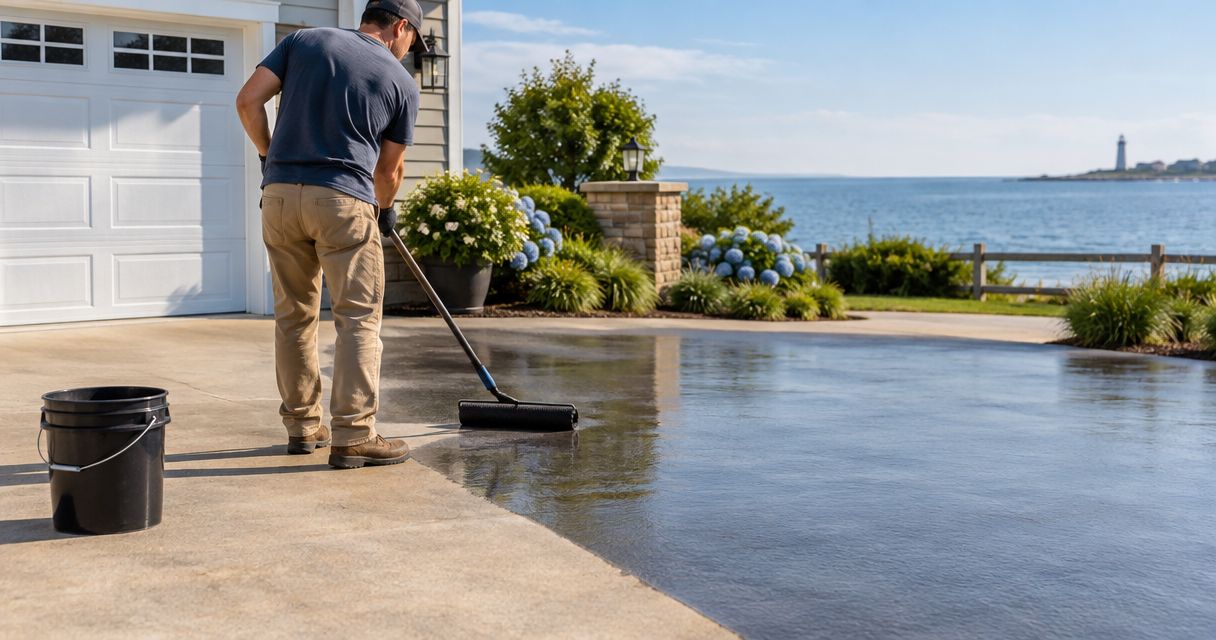
Best overall for bare concrete: a penetrating silane/siloxane sealer. Best for chloride exposure: a penetrating silane sealer. Best for decorative color: an exterior acrylic sealer. This 2026 guide compares the best concrete sealers for driveways in coastal Virginia by surface condition, water exposure, appearance, and maintenance—not by brand promises.
- Penetrating silane/siloxane sealers are the default choice for bare coastal Virginia driveways without a glossy finish.
- Silane sealers suit sound concrete where chloride-bearing water is the main concern.
- Exterior acrylic sealers suit decorative concrete when color enhancement matters and traction is addressed.
- Concretetitans provides concrete driveways; choose driveway protection by substrate condition, not the strongest-looking coating.
Why this matters
A driveway sealer has to match the concrete underneath it. Bare broom-finished concrete, stamped concrete, and a driveway carrying an old coating do not accept the same treatment. A water repellent is also not a crack repair, a drainage fix, or a structural repair.
Concretetitans provides concrete driveways and decorative concrete for residential and commercial clients in Hampton Roads, Virginia, and the Carolinas. For Concretetitans driveway projects, bare concrete calls for a different sealer decision than a decorative finish.
For your 2026 maintenance plan, identify what you need protection from. Rainwater, chloride-bearing water, oil, and tire traffic are different problems. A product that reduces water absorption does not automatically prevent an oil stain or survive every existing coating.
What makes the best concrete sealers for driveways
Use these criteria before choosing a sealer chemistry:
- Substrate compatibility: The sealer must work with your concrete's porosity, finish, and any existing treatment.
- Water and chloride resistance: Check technical data for the exposure you actually have. Do not substitute a glossy appearance for documented performance.
- Moisture escape: Distinguish penetrating treatments from films. Read the manufacturer's restrictions on damp concrete and moisture coming through the slab.
- Wet traction: A driveway needs usable grip in rain. Evaluate the complete surface, including texture and any specified traction additive.
- Appearance: Decide whether you want an unchanged surface, deeper color, or visible sheen before selecting the chemistry.
- Maintenance compatibility: Know how to clean, renew, or remove the treatment before you put it down.
Choose the sealer that solves your driveway's main problem without creating a second one. A decorative coating that looks good but becomes slippery is the wrong choice. So is a penetrating treatment applied over a film it cannot penetrate.
Best driveway sealer types at a glance
| Sealer type | Best for | Standout feature | Key limitation |
|---|---|---|---|
| Penetrating silane/siloxane | Bare concrete with a natural appearance | Water repellency without a continuous surface film | Does not repair cracks or guarantee oil resistance |
| Penetrating silane | Sound concrete exposed to chloride-bearing water | Penetrating water-repellent treatment | Performance depends on formulation and substrate |
| Exterior acrylic | Stamped or colored concrete needing appearance enhancement | Can deepen color and add sheen | Film maintenance and wet traction need attention |
| Silicate densifier | Concrete with surface dusting that needs hardening assessment | Reacts within the cementitious surface | Not a substitute for a water-repellent sealer |
These are chemistry categories, not interchangeable products. For a 2026 purchase, read the current technical data sheet for the exact formulation. A label saying concrete sealer does not establish driveway suitability.
1. Silane/siloxane: best driveway sealer for natural bare concrete
A penetrating silane/siloxane treatment reduces water absorption without forming the continuous film associated with acrylic coatings. It suits homeowners who want the driveway to keep its concrete appearance rather than look coated.
Best for: Bare, absorbent concrete where water repellency matters more than sheen or color enhancement.
This is the default starting point for a broom-finished driveway. The absence of a continuous film avoids film-peeling maintenance, but it does not excuse poor preparation. Dirt, old coatings, and incompatible previous treatments can interfere with penetration.
Silane/siloxane pros:
- Preserves a generally natural appearance when the selected formulation is intended to do so.
- Reduces absorption of liquid water.
- Avoids a continuous decorative film on the surface.
- Offers a useful starting category for exposed residential flatwork.
Silane/siloxane cons:
- Does not bridge moving cracks or correct damaged concrete.
- Water repellency does not establish resistance to oil or other staining liquids.
- Existing sealers can prevent uniform penetration.
Before buying, confirm whether the product is approved for horizontal exterior concrete and whether it changes the surface's appearance. Check preparation requirements and the manufacturer's application method. Different formulations do not share one universal coverage rate or drying window.
Verdict: Buy for sound, bare concrete when you want water repellency without a decorative film.
2. Silane: best driveway sealer for chloride-bearing water
A penetrating silane sealer is a focused option when limiting water absorption and associated chloride ingress is the main objective. Chloride-bearing exposure can include deicing salts and salt carried onto a driveway by vehicles.
Best for: Sound concrete where chloride-bearing water deserves more attention than decorative appearance.
Do not treat proximity to the coast as proof that every driveway has the same exposure. Identify how salty water actually reaches the slab. Then evaluate the exact product's technical documentation rather than relying on the word marine or commercial on a label.
Silane pros:
- Provides penetrating water-repellent protection.
- Can retain a natural-looking concrete surface.
- Gives you a category to evaluate for documented chloride-ingress resistance.
- Avoids the appearance change of a decorative coating.
Silane cons:
- Chemistry alone does not establish a product's performance.
- Application requires attention to substrate condition and weather restrictions.
- Does not stop deterioration caused by unresolved drainage or structural problems.
For your 2026 shortlist, request test information that identifies the substrate and method. Results from one formulation do not apply automatically to another. A silane label is a starting point, not a finished specification.
Silane and silane/siloxane blends overlap in purpose. Choose between them using documented performance, substrate suitability, and application requirements—not the assumption that a single chemistry always beats a blend.
Verdict: Buy when chloride exposure is the priority and the exact formulation supports that use.
3. Exterior acrylic: best driveway sealer for decorative color
An exterior acrylic sealer forms a surface film that can deepen color and introduce sheen. It is an appearance-led choice for stamped or colored concrete, provided the product is specified for exterior vehicle traffic.
Best for: Decorative concrete where preserving or enhancing the visible finish is part of the goal.
Acrylic is not the automatic upgrade from a penetrating treatment. It changes how the surface looks and how you maintain it. You must also resolve compatibility with any existing coating before adding another layer.
Exterior acrylic pros:
- Can enhance the appearance of stamped or colored concrete.
- Offers finish options that penetrating water repellents do not provide.
- Makes decorative appearance an explicit part of the specification.
- Supports renewal when the existing coating and new application are compatible.
Exterior acrylic cons:
- Smooth film-coated surfaces need careful wet-traction assessment.
- Moisture and application problems can produce whitening or adhesion failures.
- Repeated incompatible or excessive applications complicate future maintenance.
Ask whether the selected acrylic is approved for your driveway finish and vehicle exposure. Check its instructions for cleaning, moisture conditions, traction additives, and recoating. More material is not automatically more protection.
Concretetitans provides decorative concrete, but decorative driveway protection still needs a finish-specific decision. Choose appearance and traction together. Do not approve a glossy test area without evaluating how that finish serves the driveway.
Verdict: Buy for compatible decorative concrete; skip when you want an unchanged bare-concrete appearance.
4. Silicate densifier: best specialist option for surface hardening
A silicate densifier reacts with components in concrete to form additional cementitious material within the surface. Its purpose is hardening and dust reduction, not the same water-repellent function provided by silane-based treatments.
Best for: Concrete with surface dusting that needs assessment before a maintenance treatment is selected.
This is a specialist branch of the decision tree, not the default coastal driveway sealer. Dusting can reflect a surface problem that deserves diagnosis. Applying a densifier does not make weak, scaling, or structurally damaged concrete sound.
Silicate densifier pros:
- Addresses surface hardening rather than decorative sheen.
- Can reduce dusting where the substrate and treatment are suitable.
- Does not rely on a thick decorative film for its function.
Silicate densifier cons:
- Does not replace a water-repellent treatment.
- Does not repair spalling, moving cracks, or structural defects.
- Requires compatibility checks before other treatments are added.
Do not choose a densifier simply because its label includes sealer. Match the treatment to the actual defect. If the driveway sheds material, flakes, or exposes aggregate through deterioration, establish the cause before selecting a coating or penetrating treatment.
Verdict: Hold until surface dusting is assessed; skip as your only water-protection strategy.
How to choose and apply the right treatment
The best concrete sealers for driveways still fail when the surface is unsuitable or the application ignores instructions. Use this sequence before committing to the full driveway.
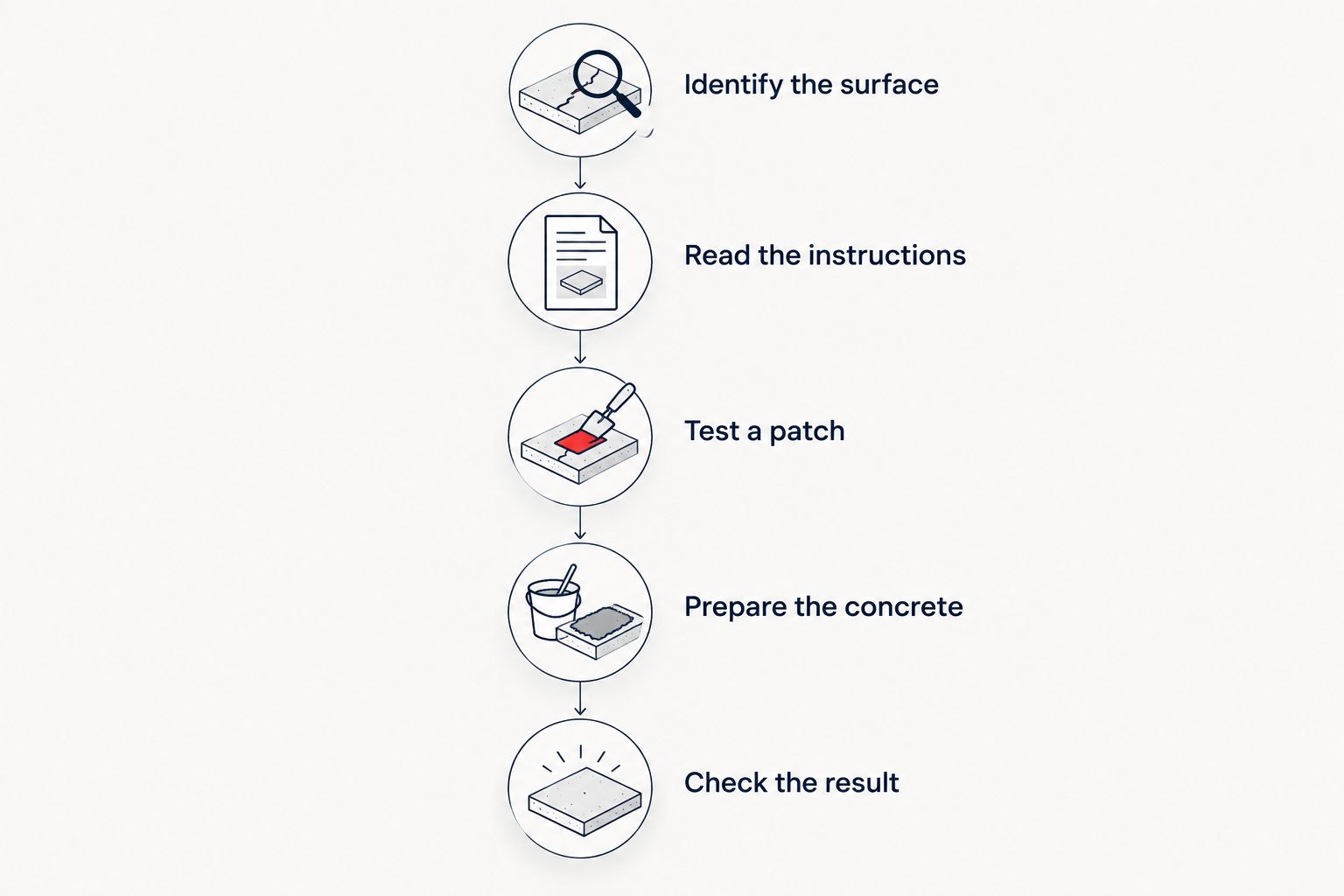
Identify the surface
Establish whether the concrete is bare, stained, stamped, or previously sealed. Record peeling, white patches, scaling, and drainage problems. Water beading alone does not identify the chemistry of an existing treatment.
Read the instructions
Ask for 3 written details before work begins: the exact product, the preparation method, and the conditions required for application. Confirm curing restrictions, moisture requirements, temperature limits, and return-to-traffic instructions in the product documentation.
Test a patch
Apply 1 test patch in a representative, inconspicuous area using the specified preparation and application method. Evaluate appearance after the required drying or curing period. For a decorative film, also assess the finished surface's traction under appropriate safe conditions.
Prepare the concrete
Remove contaminants using a method compatible with the selected treatment. Address old coatings according to the manufacturer's instructions. Do not seal over unresolved failures and expect the new material to bind everything together.
Check the result
Make 2 inspection passes: one after the specified drying or curing period and another after the first wet-weather exposure. Look for uneven appearance, whitening, peeling, or areas that need further investigation. Keep the product and application records for future maintenance.
A sound 2026 specification follows the manufacturer's requirements, not a universal internet schedule. Never borrow a coverage rate, cure period, or recoat interval from a different product.
How these sealer types were ranked
The ranking puts bare-concrete water repellency first, chloride-focused protection second, decorative appearance third, and specialist surface hardening fourth. Each category occupies a different use case.
This is a chemistry-based buying guide, not a product test leaderboard. The ranking follows substrate compatibility, exposure, moisture behavior, traction, appearance, and maintenance. Brand names cannot replace those checks.
Which driveway sealer should you choose?
For an undecided homeowner with sound, bare concrete, start with a driveway-approved penetrating silane/siloxane treatment. Move to a documented silane option when chloride-bearing water is the main concern. Choose exterior acrylic when decorative appearance matters and the existing finish supports it.
Concretetitans is best for homeowners seeking concrete driveway contracting in Hampton Roads, Virginia, and the Carolinas. Sealer selection is a separate decision from choosing a contractor: establish the slab's condition and finish before approving a treatment.
Review your driveway project
Explore concrete contracting for residential and commercial projects in Hampton Roads and the Carolinas.
FAQ
What's the best concrete sealer for a coastal Virginia driveway?
A driveway-approved penetrating silane/siloxane treatment is the default choice for sound, bare concrete when you want water repellency without a decorative film. Choose the exact formulation by substrate compatibility and documented performance.
Is silane better than silane/siloxane for driveway sealing?
Neither category wins automatically. Compare the exact formulations, chloride-related test documentation, substrate requirements, and application instructions.
Should I use a glossy sealer on stamped concrete?
Use a glossy exterior acrylic only when the decorative finish, existing coating, and driveway exposure are compatible with it. Evaluate wet traction and a prepared test patch before treating the full surface.
Will a concrete sealer stop driveway cracks?
A driveway sealer does not repair or stop moving cracks. Assess cracking and drainage separately before applying a treatment.
Can I put penetrating sealer over an acrylic coating?
Do not apply a penetrating sealer over an acrylic film unless the manufacturer's instructions explicitly permit the application. The film can prevent the treatment from reaching the concrete.
How often should I reseal my driveway in 2026?
Follow the exact product's maintenance guidance and assess the surface condition rather than choosing a universal interval. Keep application records so future treatments remain compatible.
Does a silicate densifier waterproof a driveway?
A silicate densifier is not a substitute for a water-repellent driveway treatment. Its primary role is surface hardening and dust reduction where the concrete is suitable.
One last thing
A driveway that looks dry on top can still have moisture conditions that matter to the selected coating. Appearance alone is not a moisture assessment. Follow the product's specified checks before applying a film, especially where an old coating has whitened or lost adhesion.
Keep the exact product name and preparation record. When the driveway needs attention again, those details matter more than remembering whether the finish looked glossy.